
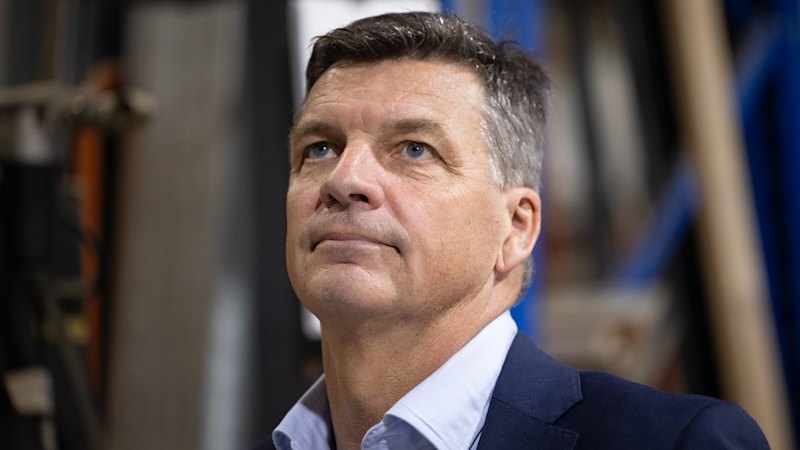
For Angus Taylor, the past few weeks have brought an unusual combination of political pressure, uncomfortable questions and unexpected headlines.
Advertisement
Only months after taking control of the Liberal Party and becoming Australia’s Opposition Leader, Taylor is attempting to rebuild a political movement still searching for its direction after a difficult period.
But August has demonstrated just how complicated that task may become.
His party is confronting the growing challenge of Pauline Hanson’s One Nation, a corruption inquiry in New South Wales has generated questions involving figures connected to the Liberal Party, and Taylor himself has found his name drawn into evidence examined by investigators.
Then, in a completely different episode, the Opposition Leader ended up injured after coming off his bicycle during a charity ride.
None of these developments means Taylor’s leadership is ending.
Together, however, they have created one of the more difficult periods since he took the job.
Questions Emerging From the NSW ICAC Inquiry
One of the most serious stories has come from hearings before the New South Wales Independent Commission Against Corruption.
The inquiry is examining allegations surrounding Catholic Schools NSW and a conservative Liberal grouping known as the Reformers.
During the hearings, messages referring to an alleged $15,000 financial commitment from Taylor were examined.
Dallas McInerney, the former chief executive of Catholic Schools NSW, acknowledged that he had approached Taylor seeking financial assistance but disputed suggestions that the money was intended as an improper donation to the Reformers.
McInerney also suggested that an associate who claimed Taylor had committed the money might have been boasting or simply lying.
That distinction is important.
Taylor has not been accused of corruption by ICAC, and the evidence aired at the inquiry does not establish that he made an unlawful payment.
Taylor himself has previously insisted that no payments were made and said he is not a party to the proceedings.
Nevertheless, for an Opposition Leader trying to rebuild his party’s reputation, having his name repeatedly mentioned around a corruption inquiry is hardly a welcome development.
The Problem Is Bigger Than One Inquiry
The ICAC hearings arrived while Taylor was already confronting another political challenge.
One Nation has been competing increasingly aggressively for conservative voters who might once have naturally supported the Coalition.
Taylor has responded by drawing a clear distinction between his Liberal Party and Pauline Hanson’s movement.
He has ruled out proposals for the Coalition and One Nation to divide seats between themselves at the next federal election.
He has gone considerably further in his rhetoric as well.
In July, Taylor warned that a One Nation government would bring an “eternity of pain” and argued that Hanson’s party was incapable of delivering the solutions Australians need.
The political calculation is difficult.
Taylor needs to win back voters attracted to One Nation without allowing the Liberal Party to become indistinguishable from it.
The Battle Became Very Public
This week that rivalry received even more attention.
A new Australian political documentary examining the battle for conservative voters placed Taylor and Hanson at the centre of the story.
Taylor questioned One Nation’s fitness to govern, while Hanson argued that she was capable of becoming prime minister.
The confrontation highlighted something larger than the personalities involved: Australia’s political right is undergoing a struggle over which party can best represent conservative voters.
For Taylor, the stakes are particularly high.
He did not inherit the Liberal leadership while the party was in a position of strength.
He became leader in February after defeating Sussan Ley in a leadership spill, having argued that the party needed fundamental change.
His own political future is therefore closely connected to whether that rebuilding project succeeds.
Then Came a Very Different Kind of Fall
Amid all of this political pressure, Taylor generated headlines for a reason nobody could have predicted.
While taking part in the Pollie Pedal charity cycling event in Queensland, the Opposition Leader came off his bicycle.
Taylor suffered minor injuries and later acknowledged that he was sore, particularly around his hip and muscles.
But there was no dramatic hospitalisation or serious medical emergency.
Instead, Taylor continued the ride.
Pollie Pedal is a long-running charity event founded by former prime minister Tony Abbott. This year’s approximately 1,000-kilometre ride is supporting Wandering Warriors, which assists Australian special forces veterans.
For an experienced cyclist like Taylor, the accident provided a surprisingly human interruption to an otherwise intensely political few weeks.
But the Political Pressure Has Not Gone Away
The much more consequential questions are waiting for him back in Canberra.
Taylor remains Opposition Leader and Member for Hume. His position is confirmed by both parliamentary records and the Liberal Party itself.
There has been no announcement that he is resigning.
There is no evidence that his political career has suddenly ended.
And the ICAC inquiry has not accused him of corrupt conduct.
But none of that makes his present situation easy.
Taylor must rebuild Liberal support while simultaneously competing with One Nation, maintaining Coalition unity and responding to questions arising from controversies involving figures within the broader Liberal organisation.
There is also pressure from within his own ranks.
Andrew Hastie continues to attract attention as an alternative conservative figure, particularly through his willingness to directly confront One Nation. Recent reporting has noted that some Liberals view him as a potential future leadership alternative to Taylor.
The Next Stage Could Define Taylor’s Leadership
When Taylor took the Liberal leadership in February, his message was essentially that the party needed to change if it wanted to survive and recover.
Six months later, that promise is being tested.
The Liberal Party is facing competition on its right. Internal arguments about its direction have not disappeared. An ICAC inquiry has generated uncomfortable headlines involving people connected to the party.
And the man responsible for navigating all of it is still relatively new to the leadership.
The bicycle accident will probably become little more than an anecdote.
The political challenges will not disappear nearly as quickly.
For Angus Taylor, the important question is therefore no longer simply how he won the Liberal leadership.
It is whether he can hold together Australia’s traditional centre-right coalition of voters while convincing those who have already walked away that there is a reason to return.