
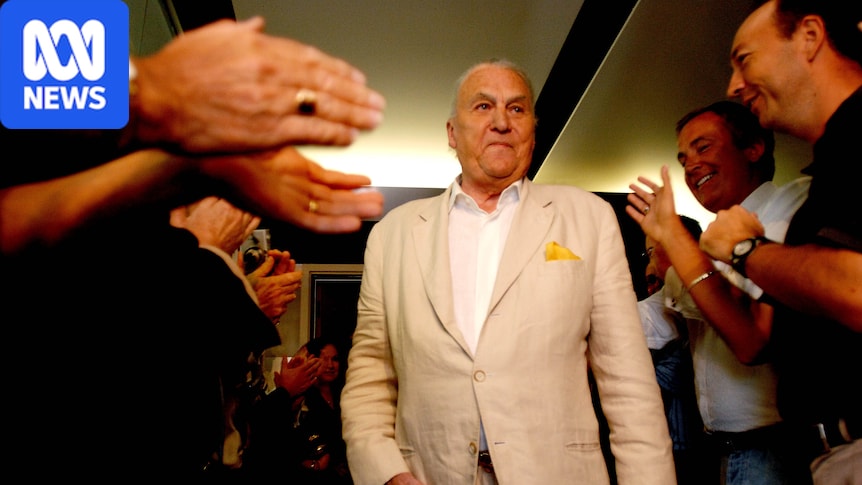
For generations of Australians, John Laws was more than a familiar name on the radio.
Advertisement
His unmistakable deep voice accompanied morning routines, long drives and political debates for decades, earning him one of the most famous nicknames in Australian broadcasting — the “Golden Tonsils”.
By the time Laws finally stepped away from the microphone in 2024, his broadcasting career had lasted an extraordinary 71 years.
Less than a year later, Australia was saying goodbye to one of the most recognisable voices in its media history.
John Laws died on 9 November 2025 at the age of 90.
The Final Chapter Had Already Begun
Laws had retired before.
In 2007, after decades at the centre of Australian commercial radio, he announced his departure from broadcasting. But retirement did not last.
He eventually returned to the microphone and continued presenting on Sydney station 2SM, demonstrating just how difficult it was to separate the broadcaster from the medium that had defined much of his life.
Then, in October 2024, Laws announced that the time had finally come.
At 89, he told listeners he would leave radio for good.
His final programme was broadcast on 8 November 2024.
This time, there would be no comeback.
Seventeen Prime Ministers And Countless Conversations
The scale of Laws’ career is difficult to capture simply by counting the years.
He interviewed 17 Australian prime ministers and became part of the country’s political conversation at a time when talkback radio possessed enormous influence over public opinion.
Politicians knew that an appearance with Laws could reach an audience far beyond Canberra.
But politics was only one part of his programme.
Listeners called him about relationships, money, family problems and everyday frustrations. At other times, conversations moved between national controversies, music and Laws’ own opinions about Australian life.
That mixture helped turn his programme into something that felt unusually personal to many regular listeners.
He Was Never A Broadcaster Everyone Agreed With
Any account of John Laws’ career would be incomplete without its controversies.
His willingness to express strong opinions was part of his appeal, but it repeatedly placed him at the centre of public criticism.
The most consequential episode came with the late-1990s “cash for comment” affair, when it emerged that commercial arrangements existed involving companies receiving favourable commentary on talkback radio.
The controversy triggered a major Australian Broadcasting Authority inquiry and became one of the defining media ethics stories of the era.
Other remarks made by Laws during his long career also attracted complaints and criticism.
It meant that his legacy was never going to be simple.
To admirers, he represented an era when broadcasters possessed distinctive personalities and were prepared to challenge their guests.
To critics, some of his broadcasts demonstrated exactly why powerful media figures needed greater accountability.
Both became parts of the John Laws story.
Behind The Famous Voice Was A More Complicated Figure
Away from the confrontational image associated with talkback radio, Laws occasionally spoke publicly about deeply personal experiences.
One of the most significant was depression.
His willingness to discuss his own experience revealed a markedly different side of a broadcaster usually associated with confidence and authority.
Laws also pursued interests well beyond current affairs.
He published poetry, recorded music, appeared on television and even produced a cookbook.
Yet whatever else he attempted, radio remained the constant.
Then The Microphone Finally Went Silent
When Laws delivered his final programme in November 2024, Australia was not simply watching another presenter retire.
It was witnessing the end of a broadcasting career that had begun when radio occupied a completely different place in Australian life.
Television expanded.
FM radio arrived.
The internet transformed journalism.
Podcasts and social media changed how audiences encountered personalities and political opinions.
Laws remained on air through all of it.
That longevity helps explain why news of his death the following year carried significance beyond the radio industry.
An Era That Cannot Easily Be Recreated
Modern Australian media bears little resemblance to the industry John Laws entered as a young broadcaster.
Audiences are fragmented across television, streaming services, podcasts and social platforms. It is increasingly difficult for a single radio personality to command the kind of national recognition that Laws enjoyed at the height of his career.
His influence was also inseparable from his controversies.
Remembering John Laws therefore does not require pretending that Australians agreed about him.
Many certainly did not.
But after more than seven decades behind a microphone, his place in Australian broadcasting history is difficult to dispute.
For millions of listeners, that voice was simply part of Australian radio.
And after 71 years, it was finally gone.